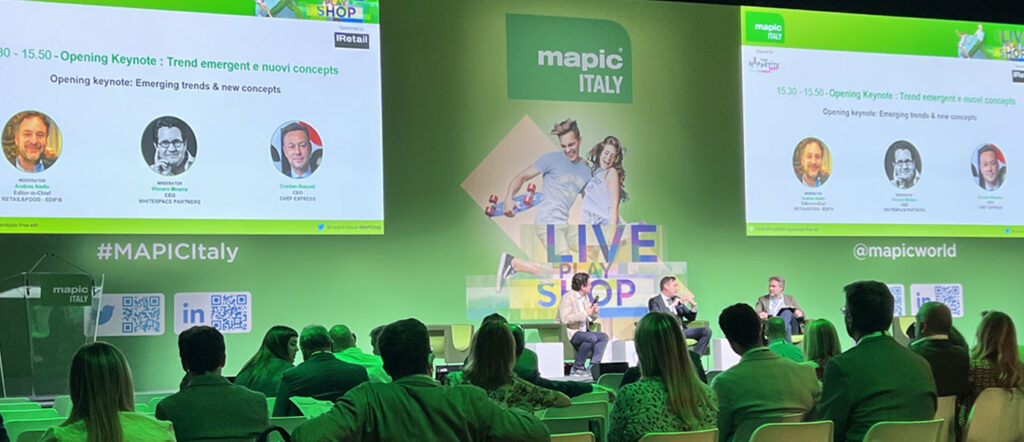
Looking at the pay off of the latest edition of Mapic 2022 "Live, play, shop" it is clear that the marketing of shopping centers is evolving towards "experience"!
Digitization, even before the pandemic, is causing new demands for change both in the management of real estate and in that of management companies.
The questions from the smoking gun is for all actors are as follows:
- How do we imagine the shopping centers of the future?
- Will the ever-increasing use of online purchases decree their end, or will they also evolve?
- And if they evolve, how will they be able to accommodate new technologies?
- Which technologies will determine the future of retail and how are these changing the shopping experience?
« I believe we will see a drastic change in retail », said Martin Lindstrom, well-known branding expert. future of retail certainly be characterized by the integration of the most recent technologies in the various dimensions of the business: from distribution and quality control to staff training, up to the planning of the shopping experience (both online and offline).
Retail is aiming to find an optimal balance between online and offline according to Martin Lindstrom who stated that "online shopping will have much more to do with the purchase and product search phase " while the " traditional brick and mortar will become a showcase » , a place in which to see up close and pick up the goods already searched for and found online.
With regard to business models that integrate online and offline, the so-called " click and mortar ", according to the expert, there is already a certain balance between the two dimensions and an emblematic example in this sense is Amazon , which several years ago decided to open physical stores, creating Amazon Go, and more recently Amazon bookstores. Even traditional brick and mortar, however, are starting to enter the online world and, as Lindstrom has stated, " this balance will be found within two or three years ".
HOW WILL THE SHOPPING EXPERIENCE CHANGE (OR IS ALREADY CHANGING)?
Stores will become much more sensory according to Martin Lindstrom. « It will be like being transported to another universe, where the experience will be driven by entertainment and storytelling », As he stated.
" The world of retail will change because stores have to redefine their function of use, " said Giuseppe Stigliano, executive director Europe at AKQA. On the function of the stores he added:
“Are they still walled off places to store goods and wait in the doorway for someone to come and buy them? If we look at them like this, we are probably doing the work of eCommerce, which however has no space constraints, no time constraints, no public holidays, etc.».
In this sense, to continue to offer added value to the consumer compared to the online store, the store must " be a place where the brand celebrated , where the product is showcased, a place where the connected experience enhanced to the product or service ".
He goes on to say: «if we observe the way in which consumers are changing their expectations and desires when they go to a physical store, we find confirmation of the collapse of the axiom according to which the purpose of a store must be the economic transaction ».
FROM ENTERTAINMENT TO SUSTAINABILITY: WHAT THE PHYSICAL STORE IS WORTH
Therefore, it would not be a question of a very distant future, but of a change already underway , which leads consumers to turn to a sales point not because they need it, but because they intend to have a specific experience, different from the online one, i.e. an experience that goes beyond functionality and aims at entertainment and strengthening the bond between brand and consumer.
Another important trend concerns sustainability , especially if we consider that, for example, Generation Z , which in the coming years will acquire ever greater importance in guiding trends in this sector, is particularly sensitive - according to studies and research - to environmental issues compared to previous generations.
Multinationals have already moved in this direction through the creation of eco-friendly stores. In brand stores such as ZARA, technology is used to create sustainable design and eco-efficient stores that even allow water and electricity consumption to reduced by up to 30% or 40% less than in a traditional store. the end, it is always a question of using the store as a privileged point of contact to communicate a specific message about the brand and its identity, but also to establish an emotional bond with the customer, necessary for loyalty and for the improvement of the brand reputation .
On what, then, will the retail of the future have to be based? consumers with three different mindsets can enter a store :
- locating : when the consumer knows what he wants and has the only need to buy a specific good and leave immediately;
- exploring : when the consumer has a certain need, " he knows he has to buy something but doesn't know exactly what " and therefore needs " an experience that helps him make the right choices ";
- dreaming : when the consumer enters a shop because he « wants to be inspired or because the brand intrigues him , but has no real need. He just wants contamination , pleasure and fun ».
According to the expert, « retail in the next few years will have to work on the second and third category ». «The retail of the future (in fact) is a retail that helps explorers to make the right choices and dreamers to be entertained, to be inspired and which leads them to a purchase ».
Among the many possible technologies , proximity are the most ready to be applied: " beacons are often mentioned, i.e. devices that with a radio signal are able to communicate with applications " created ad hoc and then send personalized messages and targeted on consumers' mobile devices based on their location, " but at the same time also to monitor, to map the flows of people within the space ".
Therefore, there are many technologies that are already transforming the sector and the way of shopping, however it is necessary that retailers know how to exploit them in the right way to make them functional to increase brand loyalty and actually useful for consumers.